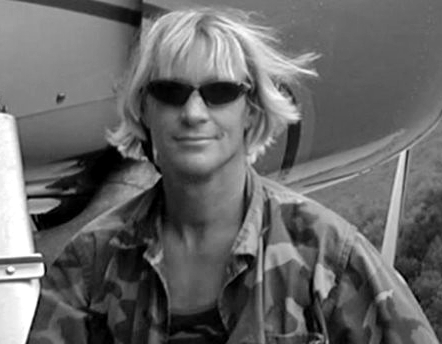

Timothy Treadwell was born on 29 April 1957 on Long Island, New York. He was a bear enthusiast and researcher, environmentalist, naturalist and documentary filmmaker. He also founded Grizzly People, an organisation devoted to protecting bears. He lived among grizzlies for 13 summers in Alaska’s Katmai National Park and Preserve. In 2003, during his thirteenth visit, he and his girlfriend Amie Huguenard were killed by a 28-year-old brown bear.
Treadwell’s life became the subject of the 2005 documentary Grizzly Man. In it, the über-*clever filmmaker Herzog portrays him as an antisocial misfit, a troubled person who directed all his energy and love towards bears because of his problems. Using recordings Treadwell made alone, the filmmaker apparently cannot grasp that someone by themselves might pull faces in a mirror, sing ridiculous lyrics, amuse themselves or have an angry outburst. He is populist enough to stamp anyone who looks in the bathroom mirror and says ‘You look like my arse’ as potentially disturbed. By creating that impression of Treadwell throughout the documentary, he arouses the audience’s curiosity and calculates his box-office takings. Instead of leaving with the impression of a naturalist whose memory deserves respect—a researcher perhaps devoted to bears to the point of obsession, but brave enough to risk his life—the audience is led to remember an obsessive-compulsive man who fell victim to his fixations and dragged his girlfriend to her death. Even though the film introduced me to Treadwell, I wanted to vent my anger at Herzog here too.
For 13 years, until the summer he was killed, Treadwell observed grizzlies closely. According to his book Among Grizzlies: Living with Wild Bears in Alaska, his mission to protect them began after he narrowly survived a heroin overdose in 1980. In the book, he says his drug addiction grew out of alcoholism. Timothy had loved animals since childhood. One day, a close friend persuaded him to travel to Alaska to observe bears. After his first encounter with a wild grizzly there, he wrote: ‘I know I’ve found my calling. My destiny is now intertwined with the bears.’
Treadwell credited these experiences among bears with freeing him from alcohol and drug addiction. Each season, he camped in the broad green clearings known as the Big Green at Hallo Bay on the Katmai coast. He called it the grizzlies’ sanctuary, and it was indeed densely populated by them. During his observations, he sometimes approached bears very closely, even touching and playing with cubs. Yet in his book, he maintains that he was always careful and had developed mutual trust and respect with them. He habitually named the bears he met, considering it the first step in the relationship he was trying to build. Park rangers, however, regarded this as harassment of wildlife. But isn’t the very concept of a national park itself a form of interference with nature? A modern name for restricting animals’ habitats? Animals lived alongside human groups throughout early history. Towards the end of the season, Treadwell moved to Kaflia Bay and camped in an area he called the Grizzly Maze, where trails from surrounding areas converged and encounters were most likely. During these experiences, he recorded more than 100 hours of video and took many photographs. He was alone in most of the videos. His girlfriend Amie joined him for the final three summers before their deaths.
By 2001, Treadwell had begun attracting press and media attention and appeared frequently as an environmental activist. He travelled between schools across the United States to teach children about bears and was featured on the Discovery Channel. He appeared with David Letterman on The Late Show and shared his experiences on Dateline NBC. With Jewel Palovak, he co-wrote Among Grizzlies: Living with Wild Bears in Alaska, a book set on the Alaska Peninsula describing his adventures. Together, Palovak and Treadwell founded Grizzly People to protect bears and wildlife.
Charlie Russell studied bears and had lived with them in Kamchatka, Russia. Russell, who also worked with Treadwell, wrote a long piece criticising his approach to basic precautions such as bear spray and electric fencing. Reflecting on the usual Alaskan response to Treadwell’s death, he wrote that if Timothy had spent 13 years killing bears and guiding others in doing so, then eventually been killed by one, he would always have been remembered with admiration in Alaska. Russell also criticised Grizzly Man as misleading, saying that if Palovak truly wanted to protect bears and wildlife, she would have worked with a filmmaker more sympathetic and fair to them. He expressed exactly how I felt.
According to Treadwell’s Grizzly People organisation, five grizzlies were lost to poaching in Katmai during the following year. However, an Anchorage Daily News report based on court records said the hunters had been operating in the Funnel Creek preserve, an area near the national park boundary where hunting was permitted. Several sources, including Nick Jans’s book The Grizzly Maze, state that Treadwell never camped near that preserve. He stayed around Hallo Bay and Kaflia Bay within the park’s boundaries and was never near it. Aircraft were the most effective means for authorities to patrol Katmai National Park’s 16,000 square kilometres.
There were constant interventions in Treadwell’s relationship with the grizzlies. From the outset, the National Park Service expressed concern about his behaviour. Its records show that rangers reported at least six violations between 1994 and 2003: guiding tourists without a licence, camping in one place beyond the seven-day limit, improper food storage, wildlife harassment and disputes with visitors and tour guides. He also frustrated officials by refusing to erect an electric fence around camp or carry bear spray. In fact, Timothy had carried bear spray and used it once. But, he wrote, he felt the bear’s terrible pain himself after using it and decided never to do so again.
In 1998, rangers found an icebox full of food inside Treadwell’s tent. On another occasion, they asked him to remove a portable generator prohibited at the campsite. Park officials then introduced a new regulation, later often called the Treadwell Rule, requiring campers to move their camp at least 1.6 kilometres every seven days. At first, he complied by travelling up and down the coast in a small motorboat and establishing new camps. Eventually, considering both the method and rule pointless, he hid his camp among dense trees, using branches and leaves to conceal it from rangers.
In 2003, Treadwell and his girlfriend Amie Huguenard, a physician assistant, arrived in Katmai National Park. He chose a streambed frequented by bears hunting salmon in autumn. That year, he came towards the end of his usual camping season, when bears feed intensively to store fat before winter and hibernation, becoming more aggressive as food grows scarce. Normally, he would leave during this high-risk period. But he extended his stay by a week to see a favourite female brown bear he had not encountered. He said he hated modern civilisation and felt better among bears in nature than surrounded by people in big cities. He repeatedly said he hated people. Many bears familiar with him from summer had already entered hibernation. Others, unfamiliar with him, were moving into the area from elsewhere in the park to find food. Footage recorded hours before his death shows a brown bear diving for salmon in the river near him. Timothy’s discomfort around this unfamiliar bear is apparent.
Around midday on Sunday 5 October, Tim spoke by satellite phone with his associate in Malibu, California, and said there were no problems. On the morning of 6 October, Kodiak air-taxi pilot Willy Fulton landed to collect them. Unable to find Tim or his girlfriend, he encountered a bear, returned to the plane and contacted park officials. A short search uncovered Treadwell and Huguenard’s remains. Tim’s severed head, part of his spine and his right arm were found a little beyond the camp, his watch still on his wrist. Huguenard’s remains lay buried beneath twigs and earth beside the torn, collapsed tent. A large male grizzly was killed when it charged the rangers recovering the remains. A second bear that attacked them was killed soon afterwards. An examination of the large male found human remains inside it. The younger bear had been eaten by other wildlife before the examination team arrived. Police examined a camera found at the campsite and reported a six-minute recording with sound but no picture: the bear’s growls and Tim and Amie’s screams of pain.
Timothy’s passion for bears and profound love for them were, in a sense, among the reasons for his death. They explained his refusal to take precautions even for self-defence. As he put it, he could not enter their home with a weapon: you cannot visit someone’s home and threaten them with a gun. He would not do it, even if it cost him his life.
In respectful memory of Timothy Treadwell.
