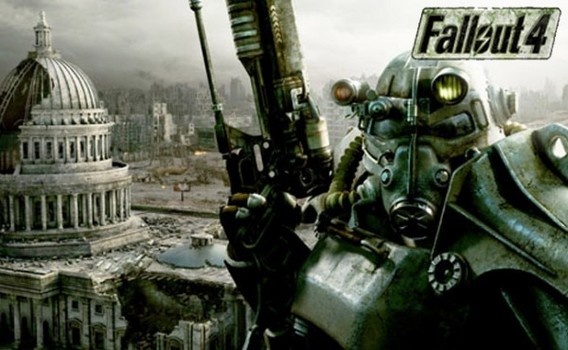
After a long, eager wait, Fallout 4 has arrived on shelves and our computers. Following those hungry, thirsty, excitement-filled days when Fallout 3 and its DLCs held us captive for hours on end, we are ready once again to struggle for survival among the remains of nuclear apocalypse.
A carefully made cinematic greets us, briefly outlining humanity’s choices and their consequences before nuclear destruction. Then our character’s face, looking into a bathroom mirror, introduces the creation screen. It is thoughtfully designed and detailed, letting you apply everything from tattoos to scars. Make an obese character, a skinny one or someone built like a bodybuilding instructor. Fallout 4’s graphics really have moved forward: the eyes look so real that they’re startling at first. Once we’ve shaped the character as we want, we continue.
My first thought was that we might be in a Vault. Looking through the window and seeing the house, I became genuinely excited. Until now, Fallout had offered little more than a few pictures and glimpses of the pre-war world. Fallout 3 players will remember discovering a Vault where people slept in chairs, their brains made to believe they were living peacefully in an imaginary pre-apocalypse American neighbourhood, completely disconnected from reality. You connected to the devices to warn them and try to free them from the false dream. Fallout 4’s first minutes begin somewhere much like that neighbourhood. Our hero is a veteran who, like many American men, has served in one war after another. With his wife and baby Shaun, he leads a partly peaceful life in a world where nuclear war looms. At first, I wondered whether we would get a few quests here or whether this was the usual Fallout calm before the storm. Soon, familiar patterns returned. A Vault-Tec employee arrives with paperwork, explains the nuclear threat and the Vaults, and says we have been selected because of our service. He asks for a signature securing our place in Vault 111. We allocate basic attributes on the next screen and return the form. While tending the baby with our wife, a television announcement startles us and the peaceful neighbourhood erupts into activity.
Here, we get a little information about the nuclear apocalypse. I suppose America, a country so fond of interfering in others’ affairs and invading in the name of peace and justice, has also reached into games and made a few adjustments. We hear China mentioned for the first time and discover that communist China’s nuclear attack on our neighbourhood and the entire Commonwealth will be the new game’s opening turning point. There is a remarkable exercise in shaping perceptions here. Commonwealth, the name of our game map, is an old English term associated with a democratic state or a community united for common interests, and also with the British Commonwealth. Was it communists who dropped the bombs on Hiroshima and Nagasaki, Yankee brother, and we somehow missed it? Throughout the game, small details continue this shaping of young minds’ perceptions of communism. American flag items also appear far more frequently in interiors than in the old Fallout. Certain quests suggest Chinese and Russian governments continually watched and spied on the Commonwealth. One involves a Chinese submarine sent to monitor the American government and destroy its ships, stranded after the nuclear attack; its commander, turned into a ghoul by radiation, tells us about it. In another, we discover a secret Russian facility. Such perception games were familiar in Hollywood’s cinema of imperialist propaganda. Seeing them reach a legend like Fallout is unfortunate: a series whose slogan is ‘War never changes’, which speaks less about countries and governments than humanity bringing about its own apocalypse, and shows us that people might even worship atomic bombs and radiation afterwards. Let me say it now: I expect those lines to become sharper in Fallout 5.
After the television’s sombre announcement, we rush towards the Vault 111 place we have only just secured. Neighbours struggle with luggage, snap that there is no room in their car when we approach, or embrace in panic. Soldiers point out the route. Stray from it and there is a flash: the bomb explodes. With a few other selected families, we pass the military checkpoint and reach the lift. We enter Vault 111 by a hair’s breadth, escaping the familiar mushroom cloud and its deadly pressure wave. We put on blue Vault suits, listen to staff instructions and head to the capsules. That ends the cinematic section: the part where we can only follow events and observe. After a few intervening scenes, we wake to discover we were frozen and roughly 210 years have passed. The Commonwealth is no longer the same.
The central story revolves around our kidnapped son Shaun. Our aim is to find him safe and sound in Fallout’s chaotic, merciless world. In Fallout 3, we searched for our father; now we search for our son. Family ties are always an effective way to connect a player to a story. Unlike Fallout 3, this map is designed for urban combat. The previous game offered more desert, dry land and valleys, with plenty of mutated scorpions and ants to kill. Here, we mostly fight raiders and mutants through ruined town and city streets. Fallout 4’s map is much more urban.
Now for some changes I noticed. The increase and variety in recurring quests stood out. Separate from main and side quests, these repeat indefinitely and eventually become monotonous. Each faction has its own. Weapon and armour upgrades are extremely varied. You can recruit companions ranging from robots and mutants to synths and humans, provided you explore. The opening hours can be difficult: in Fallout, there is always the chance of meeting a Behemoth at level four. A skull appears above enemies far beyond your level, warning that they may be lethal. Your options are to kill them stealthily if your ability and weapons allow it, or get out quickly.
As mentioned, weapon upgrades offer considerable variety. Different modifications can turn the same basic weapon into versions with completely different characteristics, and you can rename your upgraded creation. Armour falls into two categories: single outfits and clothing that accepts separate armour pieces. Some outfits prevent you from adding arm or leg pieces, though headgear remains possible. They are worn, and upgraded if possible, as one unit. Others, such as Vault suits, accept additional pieces obtained from enemies or traders, allowing many combinations. Upgrades can improve basic attributes such as Strength, balance, Luck and carrying capacity. Some enemies mutate when near death, returning to attack with greater strength. These legendary enemies drop starred weapons, armour and pieces with special effects. The item itself may be an ordinary weapon, but the extra property makes it special: a powerful mutated enemy might drop a Hunting Rifle whose rounds inflict additional fire damage and set the target alight.
Now to Power Armour and its changes. Longtime Fallout players know these suits, associated with the Brotherhood of Steel and offering the greatest protection in the game. Earlier games required special training, but Fallout 4 introduces a completely reworked concept. You no longer simply click and put it on like clothing. After inserting its nuclear battery, you climb aboard, so to speak, as befits it. With many new features, Power Armour will be a major ally, provided we find plenty of Fusion Cores. These nuclear-style batteries power the suits and aren’t especially common. Buying them requires substantial savings because they’re expensive. Meet a Deathclaw early and Power Armour is almost essential. Enemy combat mechanics have also changed: Deathclaws no longer merely swipe. Get close enough and they grab you, slam you into the ground or climb on top to claw you.
Many creatures have been added. Mutated deer come to mind, their appearance recalling photographs of babies and children born with deformities after nuclear accidents in Russia and Japan. Then there are Yao Guai, which I take to be mutated bears. They absolutely soak up bullets: empty everything you have into them and they still barely die.
Super Mutants generally don’t travel alone. They have giant mutated dogs that alert everyone with a frightening roar when they spot you.
Ghoul designs have improved considerably since Fallout 3 and look much more frightening.
Each companion can grant a special perk, something worth paying attention to. Travel with them for a while and make decisions they approve of. Once their trust is fully developed, you receive perks offering useful advantages.
Fallout’s underlying structure depicts a post-nuclear world with tremendous visual elegance, then explores the social and political interests and balances among factions with different races, beliefs, lifestyles and expectations. That never changes. Beyond the large, powerful groups, many smaller, inward-looking regional communities exist. You can join one side and become hostile or distant towards others, or balance relationships and follow your own path, preserving access to their quests. Fallout 4 has four major factions you can join, some mortal enemies and others merely distant: the Minutemen, Railroad, Institute and that Fallout staple, the Brotherhood of Steel. Briefly:
MINUTEMEN:A movement dedicated to protecting Commonwealth communities from raiders, Super Mutants and other bands of thieves and killers: a kind of defensive militia. Unlike Fallout 3, Fallout 4 lacks an established force protecting ordinary people. Where the earlier game had armies, this one is pure chaos, with killers and raiders roaming freely. The Minutemen arose to fill the gap. But their general died in a major battle while we were frozen, and they gradually dwindled and scattered, losing control and security. The historical name comes from militias during the American War of Independence, named for their ability to organise and respond rapidly. Composed largely of young, enthusiastic civilians, these groups emerged during that revolutionary period. The game makes many references to them, from clothing to names.
THE INSTITUTE:The Institute is a secret, technologically advanced organisation that terrifies Commonwealth residents. It abducts people for experiments and cannot be reached. Nobody knows where its headquarters are, who leads it or much else. Turning abducted people into cyborgs, it appears as the strongest faction. Through it, we encounter a new life form: synths. Originally developed as human-skeleton-shaped robots faster and stronger than humans, they have advanced through years of research using human subjects into human–robot hybrids indistinguishable from people. Having reached that technological point, the Institute assumes a godlike role, treating synths as the society of the future.
RAILROAD:The Railroad is a secret organisation we encounter in Fallout 4, born in opposition to the Institute. It aims to destroy it and rescue synths trapped between the Institute and public hostility. These cyborgs have everything human about them, and their appearance is almost impossible to distinguish from ours. Local people see these products of ruthless experimentation as enemies, not entirely without reason: the Institute uses synths for assassinations and replaces kidnapped people with them to infiltrate society, creating widespread paranoia. Rescuing them, some unaware of what is happening, is the Railroad’s priority. As we progress, we discover that much of its team consists of escaped synths and doctors.
BROTHERHOOD OF STEEL:Nobody wears Power Armour better. An essential, longstanding Fallout faction, the Brotherhood is familiar to anyone who has followed the series. Unless we join, we encounter it less often in Fallout 4’s quests than in earlier games. Embodying ‘If you’re not with us, you’re against us’, it feels like the ancient knightly ideal combined with technology. A strict military arm of the Fallout world, it always puts duty and hierarchy first, and keeps that stance here. Early on, it is one of the most effective forces against raiders and outlaws. Knights control the region with Vertibirds; you’ll often see them fly overhead, land ahead and enter combat. Raiders and Super Mutants are plentiful but easy prey. The Brotherhood generally faces the more dangerous Gunners, effectively raiders with military training and much better weapons and equipment.
There are many gameplay additions, but one entirely new Fallout feature offers enormous potential for fans of single-player open worlds, even if it needs development. Settlements of ordinary survivors are scattered across the map. Help them and earn their trust, and you can manage the area—redesign it completely, from beds and chairs to pictures on walls. Food, water, security and shelter become your responsibility. Scrapping waste converts it into stored resources, making you feel responsible for the place. You control residents’ weapons, armour and work assignments too. Build a radio beacon and you signal to people seeking a safe home. Population rises, along with its needs, and suddenly the game becomes a simulation. Naturally, a newly integrated system has many problems. But with DLC and updates, it could become a wonderful long-term cycle keeping you playing well after the quests end. Imagine The Sims integrated into Fallout. You can establish trade routes between towns, open clinics and bars. I have doubts about its long-term future, though. Today’s developers don’t want single-player games to occupy us for too long, largely because of revenue. Even a game like The Elder Scrolls: Skyrim continuing in multiplayer form reflects the desire for easier money. Building a single-player RPG with a deep story takes considerable time and effort. DLC, multiplayer and paid servers provide recurring income without always producing something new. I’m not simply objecting: a huge audience downloads these masterpieces through torrents rather than buying them. In that context, I suspect this new Fallout 4 system may develop through paid DLC items and settlement updates. Time will tell.
I played Fallout 4 for about a month, averaging five or six hours daily. After finishing the main story and side quests I encountered, only repetitive tasks remained, so I moved on. A few weeks later, I reopened it for a wander and discovered Vault 81. For the first time, I saw a functioning Vault with healthy people inside: a sizeable community that survived nuclear apocalypse, isolated from the outside world and untouched by radiation. It brought many new quests. Ultimately, you never know what you might find or where in Fallout’s world.
With Respect to the Developers.
POSITIVESVisual expectations vary, but I found the graphics tremendous. Character designs are beautiful.
Combat mechanics and AI are satisfying.
The many additions haven’t damaged the distinctive atmosphere. On the contrary, they’re good enough to create new Fallout fans.
Voice acting and sound are excellent. They also use music from The Terminator, perhaps to create a subconscious connection between synths and Terminators.
NEGATIVESGiven a game whose story and atmosphere comfortably place it among the top three RPGs on the market, listing faults almost feels disrespectful. Still, I can’t avoid mentioning them.
I don’t know whether it’s an optimisation issue, but many Steam forum users mention it too: open areas, especially those packed with buildings, suffer noticeable frame-rate drops, sometimes almost freezing briefly.
The main story and side quests felt a little short, compared with earlier Fallout games. For an average player, the length and variety are perfectly reasonable.
The new settlement design and management system remains underdeveloped. You can’t clearly feel its effects or the return on all your work. It’s like writing on water. Eventually, beyond beds, food and water, the rest feels empty.
CONSOLE COMMANDS
Real RPG players don’t cheat. That’s a firm, unchanging opinion of mine. But perhaps you may feel the need. After completing quests, console commands can help explore the game’s limits and reveal development details from another angle. That’s how I see it. Google already offers encyclopaedic information and documentation about Fallout 4’s console. I want to note a small selection of specific commands you may need. Don’t trust links circulating as ‘Fallout 4 trainers’; almost all are viruses or Trojans. Fallout supports a console, and its commands are all you need.
TIM:Unlike the familiar TGM god-mode cheat, TIM offers a somewhat more realistic experience. Health keeps falling, as do Action Points and ammunition. Its shared feature with TGM is that health never reaches zero, so you don’t die. TIM lets you deceive yourself into feeling a little less like you’re cheating when you’re stuck somewhere difficult.
TCL:TCL lets you bypass collision, a familiar trick for experienced players. Gravity disappears and you become light as a bird, intangible as a ghost. You can travel through the sky and pass through walls and doors. If you get stuck somewhere, perhaps because of a bug, TCL can free you.
TGP:TGP is useful for people sharing their gameplay on social media. It freezes the game, making it easier to capture beautiful scenes and screenshots.
ADDITEM:The additem command lets you obtain the items, weapons and armour you need. Find the item’s ID online.
For example, ‘additem 000000F 5000’: five thousand caps, Fallout’s metal bottle-cap currency, have just appeared nice and warm in my wallet.
COC QASMOKE:This teleports you to an area containing all the books, items, raw materials and armour. In short, everything you can find around the game is there in containers, including quest items. You can’t leave using the Pip-Boy, so use coc again with another location’s console name.For example, ‘coc RedRocketExt’ for the Red Rocket truck stop.
UNLOCK:This opens safes and terminals beyond your skill. Open the console, enter unlock and select the safe or terminal with the mouse. I strongly advise against it, however, because it removes the challenge and excitement of finding passwords and keycards. Use your companions instead.Cait, for example, can pick locks of every difficulty. Just give the order; after a few attempts, she opens them. Likewise, detective Nick Valentine makes terminals child’s play.
I particularly want to emphasisethat using cheats inside a settlement you manage can confuse its Pip-Boy statistics. The Workshop tab may show Defence 5 and a warning when the actual value is around 30. Use cheats only temporarily to escape very difficult situations. Have I used them? Yes, but ask me why. Trapped alone in a tiny room with a Mother Deathclaw, repeatedly torn into aesthetically pleasing pieces, I got angry, created a little Nagasaki with my Fat Boy and turned it to dust. Speaking of the Fat Boy, the fight with Kellogg, that Stealth Boy-addicted psychopath, may challenge many of you. It depends on how far you have developed your character before arriving, because the main story advances rather quickly independently of side and recurring quests. If you can’t kill him, here’s advice rather than a cheat. On the way, a terminal-opened storeroom contains a lovely Fat Boy. Take it. If you haven’t found a nuke yet, one is waiting beside it. After the dialogue with Kellogg, there are a few more words before combat begins. At that moment, move as far away from him and his followers as possible, fire, and the room will be spotless within seconds.
Another suggestion from experience: a trader visits Sanctuary Hills whose name I can’t recall. She’s rather abrasive. In your first conversation, a yellow option lets you demand money. If persuaded, she gives you a little, but you can never trade with her afterwards, and she makes digs whenever she sees you. It didn’t stop there in my game. I left a Fusion Core in my Power Armour and returned to find it missing. Then I spotted someone stomping along in Power Armour, a loaded cow following behind. The crafty woman had stolen my suit. She’s the NPC who taught me never to leave Power Armour with its fuel installed.