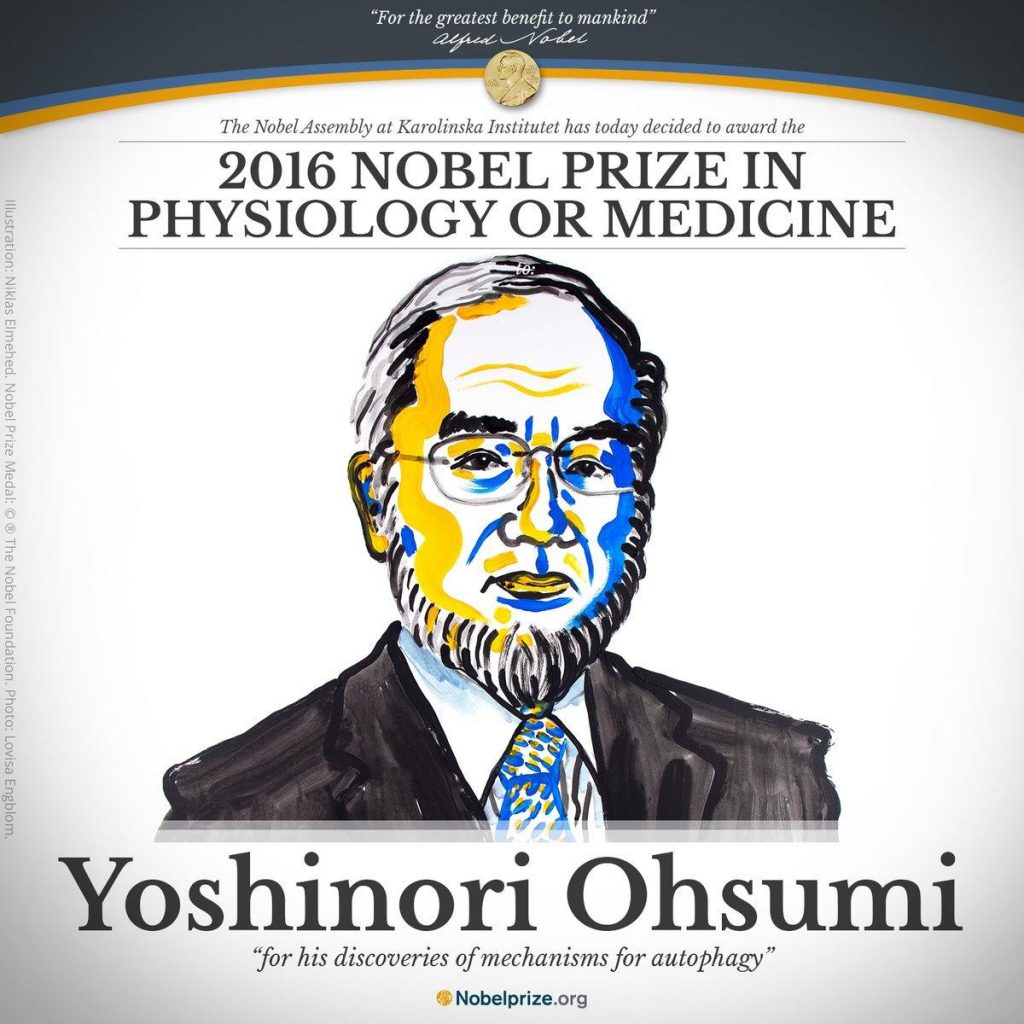
In its 2016 announcement, the Nobel Committee stated that the year’s Prize in Physiology or Medicine had been awarded to the Japanese scientist Ohsumi for discovering and explaining the mechanisms underlying autophagy, a fundamental process through which cellular components are broken down and recycled. The announcement also stated:
“Ohsumi’s findings have enabled us to understand how a cell breaks down its own contents. They have also helped us recognise autophagy’s essential importance in many physiological processes, including adaptation to starvation and the response to infection. Mutations in autophagy-related genes can cause disease, while autophagic processes play important roles in conditions such as cancer and neurological disorders.”
In 2012, Nobel laureate Ohsumi had said that autophagy was not a particularly popular subject.
The Japanese scientist said, “I am not a very ambitious person. That is why I look for new research topics even if they are not popular. When you begin researching something new and straightforward, there is a great deal to do.”
Before discussing this Nobel-winning mechanism in more detail, let us first look at the mechanisms of cell death.
Cell-death mechanisms were first proposed in 1972. Two types of cell death were described:Apoptosisis a mechanism of programmed cell death found in multicellular organisms and controlled by genetic material. It allows the body to get rid of cells that are no longer needed or have become abnormal. Also known as programmed cell death, it plays a role in many fundamental functions, including the development of multicellular organisms, cellular balance and defence against pathogens.Necrosisis an unprogrammed mechanism of cell death occurring in tissues and cells. It is often caused by conditions such as burns, injuries, infections and cancer. This mechanism comes into play in the cell when sudden damage occurs.
Following these studies, Clarke’s work in 1990 described a third type of cell death. Morphological descriptions and molecular studies identified another of the major death pathways, considered an addition or alternative to apoptosis:Autophagy.Autophagy is described in the literature as “a cellular stress response and death mechanism”.
Unlike apoptosis, studies have shown that autophagy helps maintain balance during nutrient deprivation or cellular stress by recycling molecules within the cell. When a cell comes under stress (factors that can cause cellular stress include pathogen infection, reduced oxygen concentration within the cell and a shortage of nutrients), this mechanism allows it to survive by enclosing some of its own contents in a vesicle and breaking them down. The cell manages in this way for a while, trying to get through the stressful conditions. Once the factor causing the stress has disappeared, it continues living by producing again the molecules it broke down through autophagy.If the conditions causing cellular stress continue for a long time, the cell keeps consuming its own contents and eventually dies..
Autophagy is, in a sense, an emergency button for the cell. If help arrives, the process allows the cell to survive. If help does not come for a long time, the cell dies. We can see that even for a cell, death is not something easily accepted.
Autophagy is also a physiological mechanism responsible for eliminating long-lived proteins, malfunctioning organelles, damaged macromolecules and pathogens. Factors such as cell density, oxygen concentration, temperature, hormones and nutritional status influence its regulation. The mechanism is important both for its close connections with other death processes and for its ability to function independently of them.
Because autophagic cell death can occur when apoptosis is insufficient, research into autophagy’s role in metabolic regulation and its molecular mechanisms has grown steadily. There is even a scientific journal devoted entirely to autophagy. When the regulation of such an active mechanism breaks down, conditions such as cancer, early dementia, certain inherited diseases, Alzheimer’s and infections may arise.
In addition to its role in biological recycling, autophagy plays an important part in the development of metabolic syndromes such as obesity and diabetes.
In cancer, autophagy has a double-edged role. Although it can act as a tumour-suppressing mechanism during tumour formation, some cancer cells are also known to use it to survive and evade chemotherapy drugs.
Another of its effects is the removal of malfunctioning mitochondria, the structures responsible for producing energy in cells. As this system slows with age, defective mitochondria accumulate, and the resulting damage to cells’ genetic material can trigger various diseases.
These age-related mitochondrial defects have been shown to play roles in cancer, damage to the brain and nervous system, and loss of muscle and strength.
Various studies have shown increased lifespans in mice and rats fed very low-energy diets from a young age. Increased autophagic activity under these conditions is considered one of the reasons.Taken together, these findings suggest that drugs capable of maintaining effective autophagy might improve quality of life in old age and could even extend lifespan. However, because cancer cells use this mechanism to survive, and because of other effects we do not yet understand, such drugs could also cause greater problems.
In this context, we hope that further clarification of how autophagy works in humans, how it is regulated and which signalling pathways control it will allow the adverse effects of future drugs to be eliminated.
The annual Nobel Prize in Physiology or Medicine gives priority to research that is both critically important to human health and promising for the future.
For illuminating this field through his work, we owe our thanks toProfessor Yoshinori Ohsumi. Of course, we should not forget the successful Turkish scientist whose name also comes to mind when we think of the Nobel Prize:Aziz Sancar. May many more of our scientists follow in their footsteps.Sources and Further Reading
1) Autophagy: Programmed Cell Death
http://dergiler.ankara.edu.tr/dergiler/28/2111/21850.pdf
2) Autophagy in mammalian development and differentiation
https://www.ncbi.nlm.nih.gov/pmc/articles/PMC3127249/